Happy Holidays 2011 Colony Eye Care – Sugar Land

Posted ago by Dr. Robert Salchak

Happy Holidays 2011 for Colony Eye Care Center Sugar Land

 We wanted to wish all of you a Happy Holiday Season for 2011. Another year is finishing up, and we wanted to thank all of you for allowing us to provide for your eye care needs.

 Traditionally, we send out a newsletter, a calendar, and our annual discount for glasses.  This year marks our first time to do this electronically.  We still have the calendars, and you can stop by to pick one up during your exam or just stop by for a visit. 

 2011 has been a big year for us, and our biggest news of the year was the purchase of the practice from a retiring doctor in Missouri City.  In May, we bought the practice of Dr. Stuart Miller, formerly known as Eyetrends – Missouri City.  We have 2 associates that see the majority of patients at the new office, and also some limited time at the Sugar Land office.  Our 2 associates are Dr. Nikki Kokel (formerly Dr. Polnick…she was recently married) and Dr. Sang Pham.  Dr. Salchak also sees patients in Missouri City several days a month.  The new office is open on Saturday, so if you find yourself in need of care during the weekend, you can call that office at 281-499-2020.

We also updated our website this year, and there you’ll find much more information about the practice and the eye care industry.  We also have a blog that posts to the website.  You can check it out at www.colonyeyecare.com.  We also are using social media as a way to communicate about upcoming events, news, and special programs.  You can “like” us on facebook, and watch out for our blog there too, and it will have useful and interesting information about your eyes.  We will soon provide the ability for you to order your contacts online through our website.  We’re also planning another trunk show this spring, and we’ll send out more information through facebook, emails and texting.

 We wanted to again thank you for entrusting your eye care needs to us, and we look forward to seeing you in 2012.  Have a blessed Holiday Season!

Age Related Macular Degeneration – Part 1

Posted ago by Dr. Robert Salchak

A common question often asked during eye examinations is “what is macular degeneration and am I at risk for this disease?”  Macular degeneration is usually referred to as age-related macular degeneration (AMD) because it’s occurrence increases with age.  AMD is the leading cause of blindness in patients older than 60.  Blindness is a very scary word to use.  In AMD, patients lose clarity in central vision.  Peripheral vision remains intact and unaffected.  Peripheral vision is very important in mobility and balance.  AMD affects the macula, the part of the retina that provides our central vision and color vision, causing it to deteriorate.  Symptoms of AMD can present as blurry central vision, a dark spot in the center of vision, difficulty recognizing faces, and when straight lines (like door frames) appear wavy.   Risk factors include your age, family history, race (high incidence in Caucasians), and some studies have shown women are more likely to have AMD than men.  There has been an association with high blood pressure, high cholesterol, obesity, and smoking with AMD. 

Stay tuned for AMD Part II, in which we will discuss the types of AMD and treatments.    Author:  Dr. Nikki Kokel, Optometrist

Happy Holiday Glasses Discount at Colony Eye Care Center

Posted ago by Dr. Robert Salchak

Colony Eye Care of Sugar Land (4511 Sweetwater Blvd) and Colony Eye Care of Missouri City / also known as Eyetrends – Missouri City (6134 Hwy 6 Colony Lakes Shopping Center) are excited to announce our annual glasses discount for the Holiday Season.  This offer is valid from December 15th thru January 14th, and the discount is for 20% off a complete set of glasses and lenses.  It’s not valid with any other offer or as an add on to a vision plan discount.

Lutein and Zeaxanthin: antioxidants for your eyes

Posted ago by Dr. Robert Salchak

Recent research has shown the connection between good nutrition and eye health.  There are guidelines for the amount of antioxidants that should be consumed in order to reduce the harmful affects of the environment.  Radiation from energy, such as the visible light spectrum, can damage the parts of the body that have direct exposure to the environment.  The eyes and skin are the only organs that are directly exposed to this energy.

Lutein and zeaxanthin are two very similar carotenoids that exist in the human retina.  A carotenoid is a naturally occurring pigment that gives many of our foods their color.  These antioxidants help to combat the affects of free radicals in the body, and they also help to filter out most of the high energy blue wavelengths of light.  Free radicals and blue light can cause aging in the eye, and help to increase the affects of macular degeneration.  Eating foods that are rich in lutein and zeaxanthin, and taking supplements that contain them, will help to reduce the risk of macular degeneration. 

It is recommended that the average adult consume at least 6-10 mg/day.  Anyone that has been diagnosed with macular degeneration, or has risk factors such as family history of the disease, should aim for 20 mg/day.  The best natural source of lutein can be found in green leafy vegetables.  Here’s a list of foods with lutein, and the amount of mgs per cup of each item:  Kale (25), cooked spinach (20), collards (14), turnip greens (12), green peas and corn (2-4), broccoli and romaine lettuce (1-2), and papaya, eggs, and oranges (<1).  It’s likely that you’ll have a difficult time getting the recommended dosage through diet alone, and supplements with lutein should be added.  You can find out more about lutein at www.luteininfo.com

Vitamin C and Your Eye

Posted ago by Dr. Robert Salchak

Recent research, by Calero et al., published in June 2011 revealed the importance of vitamin C for proper functioning of retinal and brain cells.  Without adequate levels of vitamin C, a receptor (GABA receptor) in the retinal cells stopped performing. In turn, improper working cells can correlate with eye diseases.  (http://www.revoptom.com/content/c/29660/).   

Vitamin C (L-ascorbic acid) is a natural antioxidant found in food.  Besides oranges, other fruits and vegetables that contain vitamin C include guava, kiwi, red and green bell peppers, strawberries, brussels sprouts, and cantaloupe.

 There are varying recommendations of the daily amount of vitamin C needed.   Pregnancy and certain health conditions can increase your need for vitamin C.  Consult with your primary care doctor to accurately determine you intake need.

Author:  Nikki Polnick, OD

More Than an Eye Exam……150 Point Inspection

Posted ago by Dr. Robert Salchak

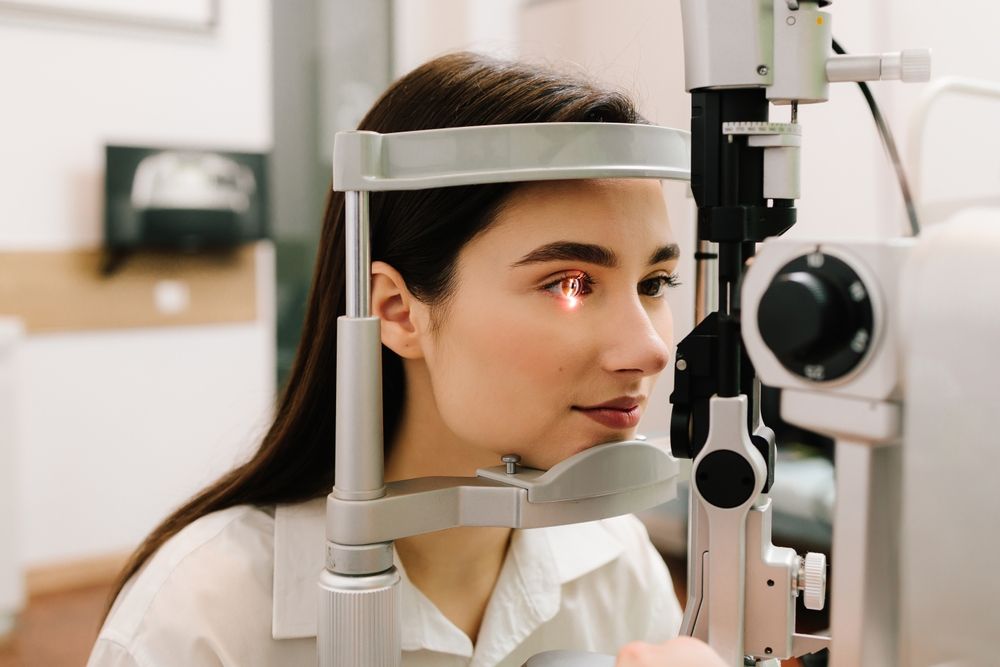
Our eyes are very much like a car.  We relay on both to get around.  So, why is it that we don’t think anything about getting our cars inspected yearly (maybe because there’s a law requiring it) but we don’t always think of getting our eyes inspected yearly?  You generally don’t wait until your car breaks down to get an inspection, so why should we treat our eyes any differently?

 Here are some of the things that we do in our 150 inspection of your eyes:

  • Eye alignment…..like getting your front end aligned
  • Glaucoma check….checks the pressure like in your tires
  • Macular degeneration……making sure your headlights and timing is correct
  • Diabetic Retinopathy…….checking for oil leaks
  • Dry Eye / Eyelid evaluation……checking the windshield wipers
  • Dilation of the pupils.……like checking under your hood

 Glasses and contacts that can help correct your vision can be like the windshield is to your car.  Scratches and dings can affect your vision, and should be repaired or replaced routinely to enhance your ability to see the best.  Plan on getting your eyes dilated while you’re getting your eyes checked.  It’s like checking under the hood of your car to assess the function of all those important parts that make your engine run properly.  We want to make sure that all the parts of your retina (optic nerve, macula, blood vessels) are in top notch working order.

 Like cars, as your eyes get older, there are more potential complications and possible breakdowns.  It becomes that much more important to do regular checkups.  You may be able to get new car parts, or even a new car, but you can’t get a new set of eyes.  Next time you get your car inspected, be thinking of getting your eyes inspected too!

 Author:  Dr. Sang Pham

Glaucoma: The silent eye disease

Posted ago by nikki.polnick

Most visits to your doctor occur when you are sick and symptoms arise.  But not all conditions/diseases have obvious signs.  Yearly wellness exams are vital to your health and also to your ocular health. The eye disease of glaucoma is normally found on wellness exams and most patients are unaware that anything is wrong.  Most are shocked because they have no symptoms and see perfectly.  Many patients go years between eye exams, and if glaucoma develops, irreversible damage can result.  Annual wellness exams are essential for detecting glaucoma.  Many components of an eye exam, including eye pressure, peripheral vision screening, and optic nerve assessment, allow your doctor to evaluate your eyes for glaucoma.  Risk factors for glaucoma include family history, ocular trauma, long-term steroid use, and ethnicity (African-American).  We recommend annual wellness eye examinations to keep you seeing great for years to come!

For more information on glaucoma, visit the Glaucoma Foundation Website www.glaucomafoundation.org

Contact Lenses and Presbyopia

Posted ago by Dr. Robert Salchak

Presbyopia, the loss of near focusing, first occurs between the ages of 35 to 45.  Early symptoms of presbyopia appear as the need to push your reading material further away from you to obtain clear vision.  Presbyopia is a natural process that is unavoidable. With glasses, bifocals or progressive (no line bifocals) lenses do the trick.  But do not rule out contact lenses!  There are many new multifocal contact lens designs that allow patients with presbyopia to have great vision at distance and near without the use or hassle of reading glasses. It’s a great time to be presbyopic!

Concerns about my eyes – Doctor vs Patient perspective

Posted ago by Dr. Robert Salchak

Why should anyone get their eyes checked regularly, and what are the concerns wrapped around this statement if you are the doctor, or if you are a patient? There may be a number of qualified answers, but from the doctor’s side of the fence, we are concerned about the health of patient’s eyes. There are some diseases of the eye, namely glaucoma, that can cause significant vision loss with no pain or discomfort to the eye. Some conditions may not have noticeable vision loss until moderate to more advanced stages of the disease. Many of these conditions can be well treated with minimal vision loss if detected in their early stages.

Patients are usually most concerned about their vision, and think they can skip annual exams if they are seeing well. Not all patients have this philosophy, but many do. They believe that if they can see everything they need to see, there’s no reason to get their eyes checked. While doctors are also concerned about providing clear and comfortable vision, we are especially concerned with having the chance to detect and diagnose visually threatening conditions. Think of your yearly eye exam as your annual eye physical. Don’t miss out on seeing the best, and keeping it that way for many years to come.

3-D Imaging of the Eye

Posted ago by Dr. Robert Salchak

Optical Coherence Tomography (OCT) is a method of using light to scan and image tissue in the body. Other types of imaging use sound or radio frequency, and the OCT is able to obtain higher resolution because of its use of light. It’s been mostly used in the detection and treatment of eye conditions by imaging the retina, cornea, and tear film. Recent developments have been used in cardiology applications to help in diagnosing coronary artery disease. Recent grants have been awarded to develop OCT devices that can be applied to imaging areas of the body such as ears, cervical tissue, and skin.

Some of the ocular condition that we can detect with our Cirrus HD-OCT by Zeiss Ophthalmics, are glaucoma, macular degeneration, diabetic retinopathy, and other retinal anomalies. The testing is easy for a patient, and it gives us incredibly detailed images of various parts of the eye. We can also image the tear film on the front of the eye in the detection and management of dry eye disease, along with measuring corneal thickness for screening lasik candidates. OCT testing is usually covered by medical insurance as long as there is a medical condition to report.